It is difficult for Zhejiang to reverse the supply of medical protection materials. "Invisible" core technology enterprises find new machines
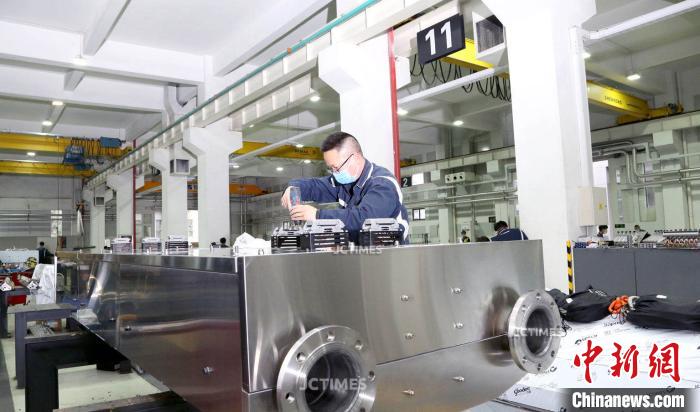
The employees in the workshop of Jingcheng Times Group are processing. Photo courtesy of Jingcheng Times Group
Zhongxin. com, Hangzhou, April 4 (Reporter Zhao Yejiao, Zhao Xiaoyan and Huang Hui) At the beginning of the outbreak of COVID-19, the production of medical protective clothing, surgical masks, temperature measuring gun and other epidemic prevention materials was in a hurry. In the face of this big exam, Zhejiang did everything possible to ensure the supply of emergency materials, and accelerated the resumption of work and production of epidemic prevention materials production enterprises in the province at the fastest speed. It took only over one month to reverse the situation that the supply of medical protection materials was difficult. The reporter noticed that some "invisible" manufacturing enterprises with leading and core technologies "surfaced" and played an important role in the big exam, not only "buffering" the impact of the epidemic, but also finding new opportunities for high-quality development in the future.
If meltblown cloth is the "heart" of the mask, then the meltblown die is the "heart" of the production of meltblown cloth, which directly determines the protective effect of the mask.
After the outbreak of the epidemic, Li Pucha, deputy general manager of Jingcheng Times Group Jingcheng Mould Machinery Co., Ltd., received numerous calls, 90% of which were directed at the "melt-blown die", and the order volume showed a blowout trend. Originally, there were only 40 or 50 sets of orders a year, and during the epidemic, the order volume accumulated to 180 orders.
On March 5th, the Development and Reform Commission of Zhejiang Province sent a letter to the company, asking it to provide Sinopec with two sets of 3.2m meltblowing dies on April 6th, but the production cycle of one set of meltblowing dies will take 3-4 months.
How to improve production efficiency and complete tasks in the shortest time?
Jingcheng Times Group promoted the production of melt-blown die to a state of emergency, mobilized the company’s reserved steel raw materials, and about 400 employees worked in three shifts 24 hours a day. "We strive to shorten the manufacturing cycle to 1-2 months. Since April, a large number of meetings will be delivered to users one after another, and two sets of melt-blowing dies of Sinopec are already being loaded today. " Li Pucha said.
Not only masks, but also small temperature guns have become hot items in this epidemic, and its core is infrared temperature measuring chip.
On the third day of New Year’s Eve, Luo Weishao, the general manager of Hangzhou Jinghua Microelectronics Co., Ltd. (hereinafter referred to as "Jinghua Micro"), received an urgent call from a colleague: "The inventory of infrared temperature measuring chips for about half a year was all booked in one day."
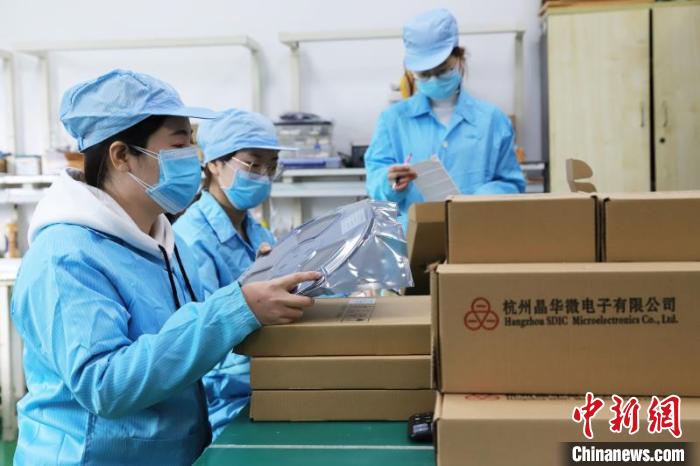
The employees of Jinghua Micro Company are working. Jing Hua Wei gong tu
Five years ago, Jinghuawei began to dig deep into the field of infrared temperature measurement, and accumulated hundreds of mature and stable overall solutions. The chips have been mass-produced and applied, and now it is the largest supplier of infrared temperature measurement chips in Chinese mainland. The company used to ship about 1 million pieces a month. In order to cope with the epidemic situation, Jinghuawei increased its production capacity by more than ten times in just a few weeks. At present, it supplies dozens of large-scale customer manufacturers, and the cumulative shipment during the epidemic period exceeded 10 million pieces, ranking first in China.
Hangzhou Haodeli Intelligent Technology Co., Ltd. mainly produces medical products such as graphene protective clothing. The company cooperated with the team of Professor Gao Chao of Zhejiang University to set up a technical research team. It took only three days to develop graphene protective clothing, and overcame difficulties such as fabric procurement, equipment renovation and insufficient staff, and raced against time to resume production and fight against the epidemic to form effective production capacity.
It is worth mentioning that as a major manufacturing province, these manufacturing "invisible" enterprises not only "buffer" the impact of the epidemic, but also usher in new development opportunities with leading and core technologies.
Twenty years ago, domestic melt-blown dies were mainly imported from Europe and Japan, and there was almost no way for China enterprises to produce high-end domestic equipment. Jingcheng Times Group is one of the earliest "crab eaters".
Starting from learning and referring to foreign advanced technology, with more practice, application and experience accumulation, combined with advanced analysis system and establishing a more professional talent team, Jingcheng Times Group successfully developed a set of self-contained products in 2015. At present, it has a market share of 60%-70% in the middle and high-end melt-blown die market, and even reached 80% during the epidemic. Because of the melt-blown die technology, Jingcheng Times Group was also included in the list of key enterprises of epidemic prevention materials related equipment in the State Council on March 3rd.
"In order to achieve medical grade, the uniformity of melt-blown die discharge is very high. The uniformity of die discharge depends on the design of die, but the design is very difficult." Li Pucha explained the technical difficulties to reporters. Through this exam, Jingcheng Times Group deeply realized that only high-quality products can come in handy at a critical moment, which further strengthened their determination to continue to develop in the direction of high quality.
When meltblown cloth is hard to find, Zhejiang Zhaohui Filter Technology Co., Ltd. has developed a new epidemic prevention material to replace meltblown cloth. On March 3rd, Zhejiang held the first recommendation conference of new epidemic prevention materials hosted by the Provincial Economic and Information Office. It was made clear at the meeting that the nano-scale film-covering material developed by Zhaohui Company is a new type of reusable epidemic prevention mask material, which is a low-resistance, high-efficiency and easy-to-clean film composite material, which can be optimized to replace the key material "meltblown cloth" in mask production and alleviate the shortage of mask production materials.
"This material can be reused for more than 10 times through simple high-temperature disinfection and cooking disinfection. Based on the company’s current planned daily output of 70,000 square meters, it is equivalent to a daily production of 17.5 million masks." The relevant person in charge of Zhaohui Company said that this research and development is an opportunity for the future development of the company.
"Our infrared temperature measuring chip can complete the functions of infrared signal amplification, analog-to-digital conversion, signal processing, transmission and display with a single chip, and its cost performance far exceeds that of similar manufacturers at home and abroad. Other enterprises need two or three chips to realize the functions of our single chip." In Luo Weishao’s view, such a comparative advantage can make its enterprises stable and far-reaching.
Through the words of Ma Rende, chairman of Hangzhou Haodeli Intelligent Technology Co., Ltd., we can also see that the opportunity is coming. He said: "During the epidemic, enterprises not only did not reduce production, but increased production. I also donated a lot of epidemic prevention materials to the front line."
Such stories are still staged all over Zhejiang. Zhejiang’s rapid response during the epidemic period lies in its long-term contribution to the manufacturing industry. The manufacturing industry has always been the foundation of Zhejiang province, a strong province and the main stage of world economic competition. Under the current situation, Zhejiang manufacturing enterprises are taking active actions to build a new manufacturing pattern in response to the changes in globalization and lay a solid foundation for building a global advanced manufacturing base.