What is the national image of China? Authoritative report released
CCTV News:The Global Survey Report on China’s National Image 2015 was released in Beijing on the 29th. The fourth global survey on the national image launched by the Center for Foreign Communication Research of China Foreign Languages Bureau in conjunction with the market research and brand consulting agency shows that the overall image of China has steadily improved, the international influence of China’s economy ranks second in the world, and China’s scientific and technological innovation ability has been widely praised.
The main findings of the survey are: the overall image of China has steadily improved; The international influence of China economy ranks second in the world; China’s scientific and technological innovation ability is widely praised, and high-speed rail is considered as the most outstanding scientific and technological achievement.
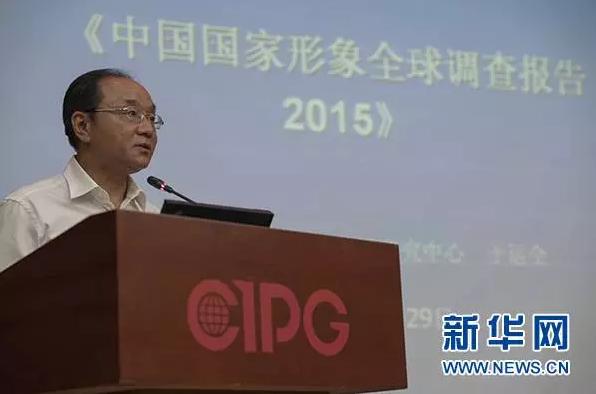
△ On August 29th, Wang Gangyi, Deputy Director of the Chinese Foreign Languages Bureau, delivered a speech at the press conference of "China National Image Global Survey Report 2015".
China’s overall image has risen steadily, and its influence on international affairs ranks second among all countries.
This survey covers 19 G20 members (excluding the EU) for the first time, with a total of 9,500 interview samples. The topics covered include the overall image and influence of China, the international image and communication of politics, diplomacy, economy, culture and technology.
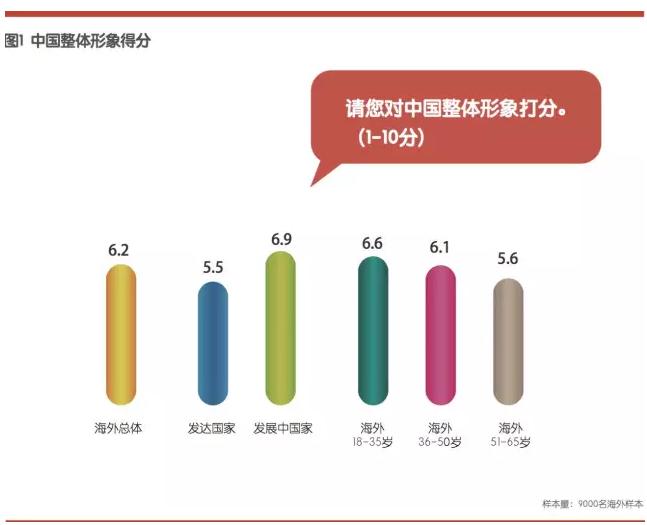
According to the report, compared with 2014, China’s overall image score increased by 0.3 points (out of 10 points). Among them, developing countries have a significantly more positive impression of China (6.9 points) than developed countries (5.5 points).
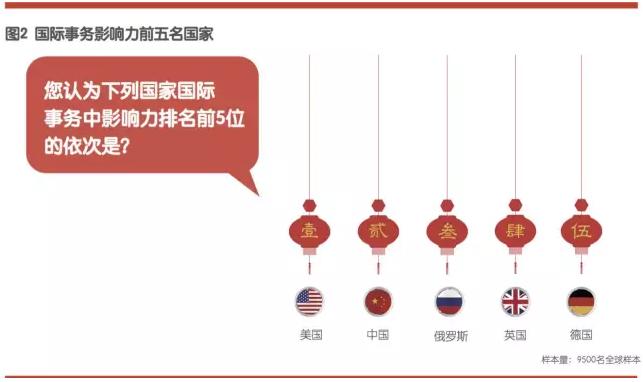
The United States occupies the first place in international affairs, followed by China, followed by Russia, Britain and Germany.
It is worth noting that compared with the older group, overseas young people (aged 18-35) have a higher understanding of China, a better overall impression and a more optimistic view of the future development of China.
Zhou Qingan, deputy dean of Tsinghua University School of Journalism and Communication, believes that this shows that China’s international communication efforts are gaining more and more enthusiasm among the future social elites, and it also shows that China’s international communication has achieved good results in the field of new media in recent years.
The great eastern country with a long history and charm is the most prominent national image.
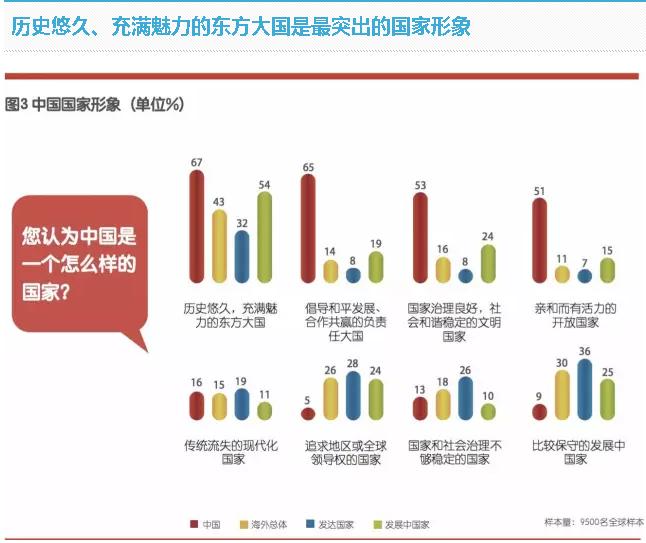
In the impression of overseas respondents, China’s image as a big country with a long history and charm in the East is the most prominent, with 43% of respondents choosing this option, and the proportion of developing countries is as high as 54%.
There are significant differences between the views of China respondents and those of overseas respondents. Compared with overseas, China respondents generally think that their country has a long history and charm, advocates peaceful development, win-win cooperation, good governance, harmonious and stable society, and is friendly, open and dynamic.
Hard work and dedication have become the most prominent national image of China.
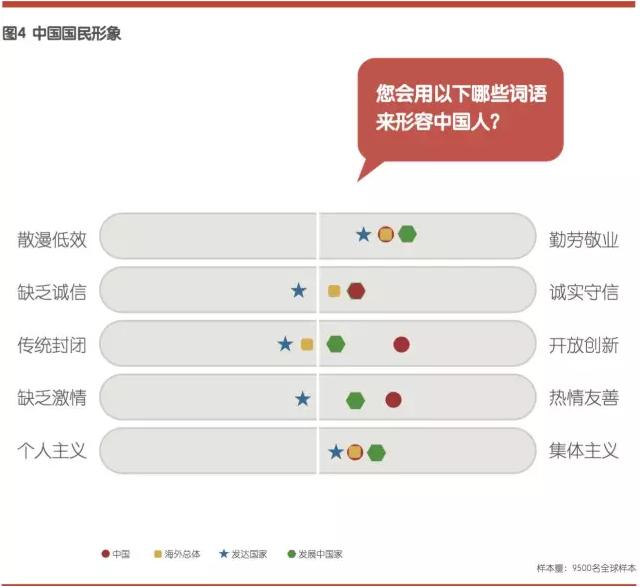
The global respondents’ impression of China citizens is generally positive. Compared with developed countries, developing countries have a better impression of China citizens.
Among the overseas respondents, the respondents who think that China citizens are hardworking and dedicated are the most, followed by collectivism, enthusiasm and friendliness, and honesty and trustworthiness. A certain number of respondents in developed countries believe that China citizens tend to be traditionally closed and lack open innovation.
Highly cohesive and well-organized is the most prominent image of China’s ruling party.
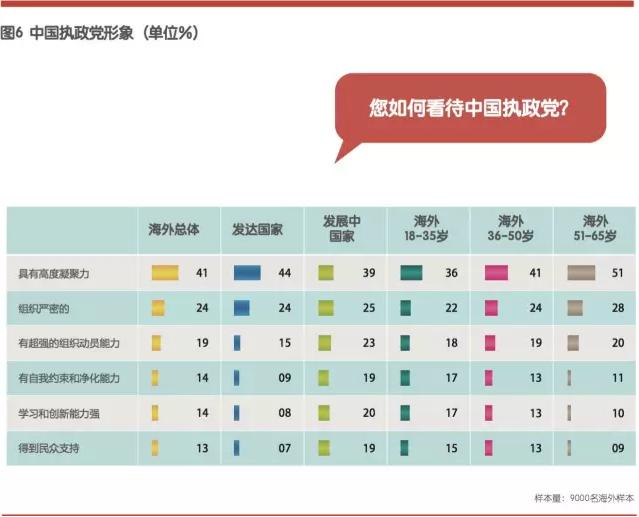
Overseas respondents’ impression of China’s ruling party is mainly of high cohesion and tight organization. Among them, a considerable number of respondents from developing countries believe that the ruling party in China has superior organizational mobilization ability and learning and innovation ability.
In terms of age, the images of "self-discipline and purification ability", "strong learning and innovation ability" and "popular support" are more recognized by young overseas groups; The image of "high cohesion", "tight organization" and "super organizational mobilization ability" is more recognized by overseas elderly groups.
Chinese medicine, martial arts and diet are the most representative elements of China culture in the eyes of overseas respondents.
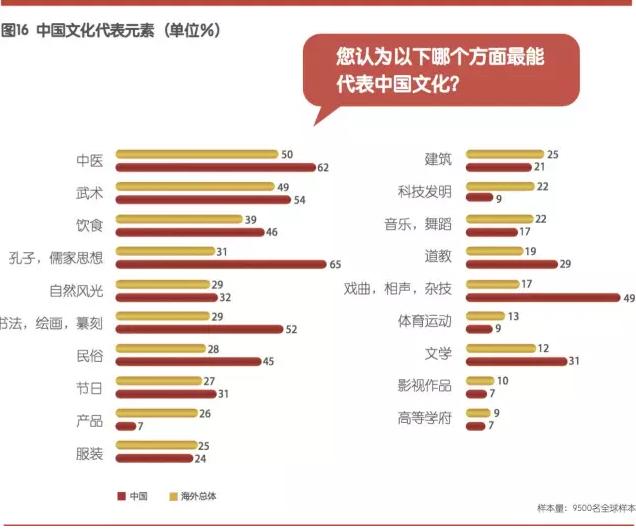
When it comes to the representative elements of China culture, overseas respondents think that Chinese medicine, martial arts and diet are the most representative, with 50%, 49% and 39% respectively.
Respondents at home and abroad have different views on the representative elements of China culture. In terms of traditional culture such as Confucianism, calligraphy, painting, seal cutting, folk customs, opera, cross talk and acrobatics, the recognition of overseas respondents as a representative element of China culture is obviously lower than that of domestic respondents, while in terms of cultural elements such as products, scientific and technological inventions, it is much higher than that of domestic respondents.
China’s scientific and technological innovation ability is well received, and high iron becomes the innovation benchmark.
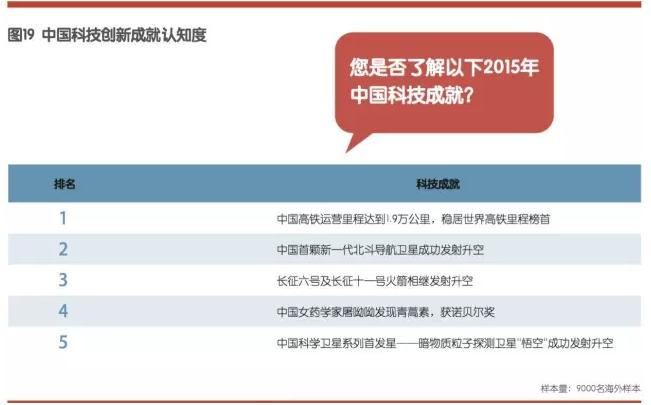
China’s scientific and technological innovation ability has become a bright color in this report. The report shows that overseas audiences have a high evaluation of China’s scientific and technological innovation ability, even surpassing the respondents in China.
China high-speed rail, which is most related to people’s livelihood, is the most recognized scientific and technological achievement in China. According to the survey, the proportion of respondents who know that "the mileage of high-speed rail in China has reached 19,000 kilometers, ranking first in the world" is the highest, reaching 21%. Respondents from developing countries have a higher awareness of this achievement.
According to Yu Yunquan, deputy director of the Center for Foreign Communication Studies of China Foreign Languages Bureau, it has been two years since the scientific and technological innovation capability was included in the evaluation, and this year’s score is even brighter than last year’s, which is inseparable from the practice of innovation-driven development strategy in China in recent years and the numerous tangible achievements.
The overseas image of China brand has improved.
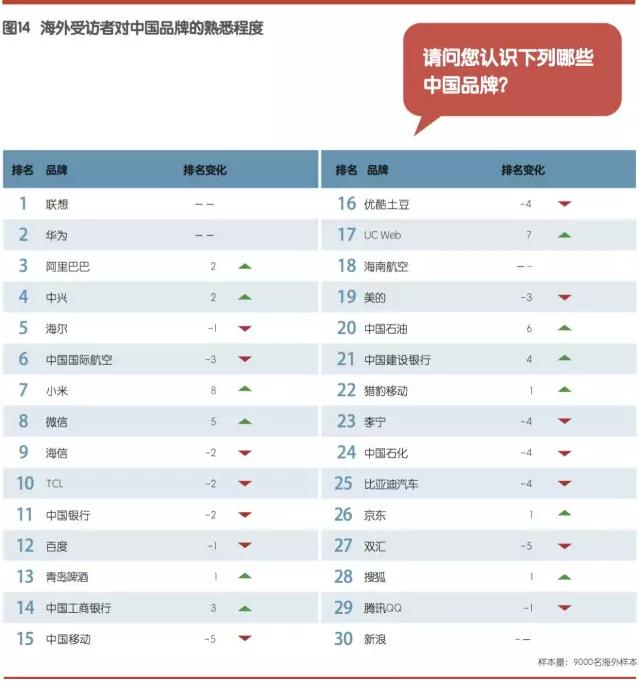
Compared with 2014, the overseas image of China products has improved, especially in after-sales service. The top five China brands that overseas respondents are most familiar with are Lenovo, Huawei, Alibaba, ZTE and Haier. The familiarity rankings of Xiaomi, WeChat, UC browser and other technology brands have improved significantly, and the ranking of China Petroleum has also increased significantly.
In terms of countries, respondents from developed countries are more worried about China brands than developing countries; In terms of age, young people trust China brand more than older people, and they have more concerns than other groups only in terms of price.
National image report helps to enhance the effectiveness of international communication.
In response to this report, Wang Gangyi, deputy director of the China Foreign Languages Bureau, said that the national image report is an important indicator to evaluate the international communication effect of a country. In the 21st century, international communication pays more attention to pertinence and effectiveness. In this survey report, the survey data of different age groups in 19 countries provide us with reference for accurate communication and differentiated communication.
Zhou Qingan emphasized the importance of deep international dialogue. He said that in the recent period when international hot and sensitive issues are constantly emerging, the goodwill of overseas audiences towards China has still increased by 0.3%, which shows that the in-depth dialogue between China and the world is conducive to enhancing the national image. (Content source: Xinhuanet, China National Image Global Survey 2015).